
LINE OF DESCENT
Your line of Canadian descent.
IRCC reviews one path through your family tree — the documentary chain from you to a single Canadian-born ancestor. Here's how to organize it cleanly.
MOST APPLICATIONS
If you qualify through a parent or grandparent, most of this page doesn't apply to you. Your vital records alone are enough — the complications below are for longer applications.
PICK ONE GEN 0
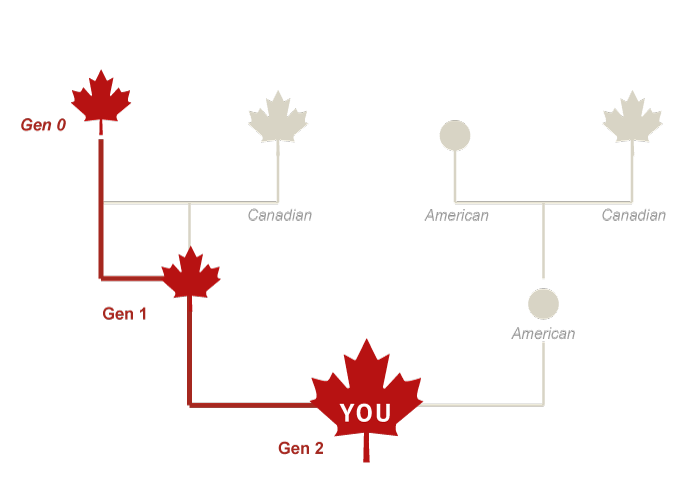
Choose one Canadian ancestor. Ignore the rest.
Many families have more than one Canadian ancestor scattered across different branches of the family tree. You only need to pick one — the ancestor furthest back who's easiest to document — and trace the line directly from you to that person. Ignore siblings, spouses' families, and any other Canadian relatives you discover along the way.
WHY THIS MATTERS
Reviewers have a limited window of attention. A clean, single-line application is faster to process than one that introduces multiple Canadian ancestors and extra family branches. Your job is to make the reviewer's job easy — not to prove every Canadian connection in your family.
WHEN THE LINE GETS LONGER
Bill C-3 opened the door to deeper applications.
Form CIT 0001 for requesting proof of Canadian citizenship hasn't been updated for Bill C-3, so it only accommodates two or three generations. Documenting longer lines of descent requires that you add supplemental data with supporting documentation. Neither the application nor the instructions tell you how to do this — only that you should include it separately.
FROM MY OWN APPLICATION
A seven-generation family application.
I put together a 7-generation application for my family. That included me at Gen 6 and my two children both at Gen 7. One of my kids was a minor with only a US passport as identification.
My Gen 0 was born in Quebec to a long line of French-Canadian families. When he was 9 years old, the family walked across the border looking for a better life. The next generation was born on US soil and automatically became American citizens.
Somewhere in that crossing, the family name LeDuc was Anglicized to LaDuke. That's one of several name changes I had to document in order to connect Gen 0 to the next generation.
The application form asks information about your line of descent in Section 9 — but it has limited rows and assumes a shorter chain. For my 7-generation application, I had to supplement Section 9 with separate documentation for each person in my line. I built templates for this — they're available on the templates page.
NAME CHANGES
Names change. Lines don't.
The single biggest complication in longer applications is that names change across generations, and IRCC needs documentary evidence of every change. Three patterns come up again and again.
01
Marriage name changes
When one spouse takes the other's name at marriage, the documentary bridge is the marriage certificate. It formally links the pre-marriage name to the married name.
02
Anglicization and spelling drift
French-Canadian families often saw their names change informally as they settled on the US side of the border. LeDuc becomes LaDuke. Beaulieu becomes Bowley. These shifts usually happened without any official document.
03
Legal name changes
When someone formally changed their name through the court system, the documentary trail is clean. Court orders and divorce decrees are the strongest evidence you can include.
VISUALIZING THE LINE
Help the reviewer see it at a glance.
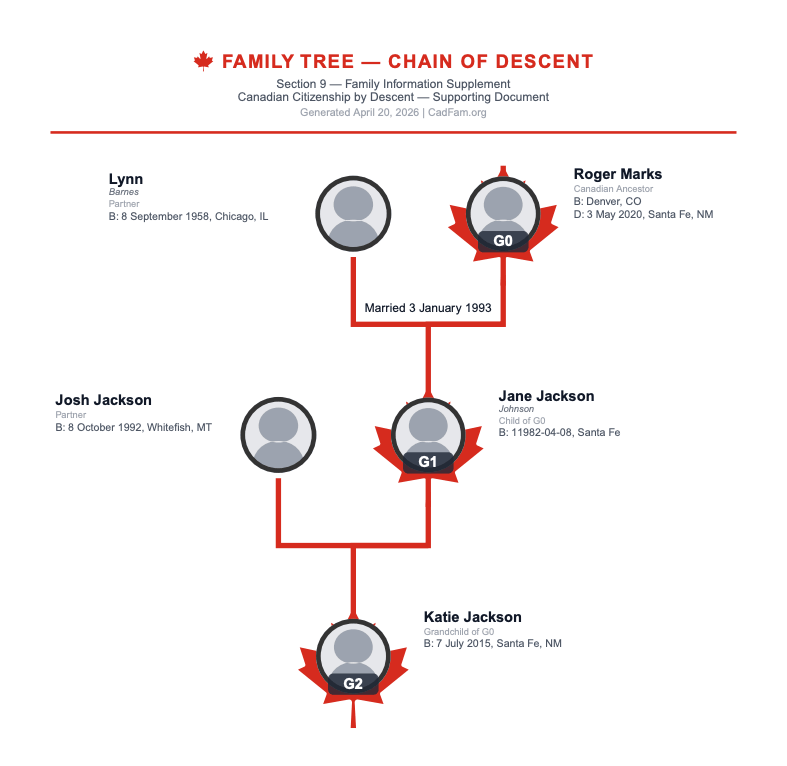
For multi-generation applications, a clean diagram of your line of descent saves the IRCC reviewer time. They can see the whole chain in one picture instead of piecing it together from your records.
FREE TOOL
CadFam
A web-based family tree builder specifically designed for Canadian citizenship applications. Enter each generation, mark citizenship status, and export a clean PDF of your line of descent.
- Visual representation of family tree
- Color-coded citizenship status
- PDF export ready for IRCC
- Free to use
Independent free tool. Not affiliated with this site.
KEEP GOING
Once you have your line, start requesting records.
Records take the longest part of the process — weeks to months, depending on the office and the season. Request them first, and prepare your CIT 0001 submission while you wait.
NEXT STEP
Requesting records
Where to find every Canadian and US record your application will need — and what to do when records don't exist.
Open the records guide →AFTER THAT
The application form
Practical guidance and templates for filing CIT 0001 — including how to handle longer lines of descent.
Open the form guide →ONE-TIME PURCHASE
Full access for $39.
Every template, every topic page, every answer. No subscription. No recurring fees.
Get the Resource Hub →Not affiliated with IRCC. Informational only.
