
APPLYING FOR A MINOR
Canadian citizenship for your child.
Applying for a minor uses the same CIT 0001 form as an adult application, but the way it's completed is different — and there's one form you can skip that parents often fill out by mistake.
FILLING OUT CIT 0001
Three things parents get wrong.
The form itself is the same one adults use. What changes is whose information goes where, which supporting form you don't need, and one signature requirement that kicks in when a child turns 14.
THE APPLICANT'S VOICE
Every answer is the child's, not the parent's.
Name, date of birth, place of birth, address — all belong to the child. The parent signs at the end as legal parent or guardian, but everything above the signature line is the child's information.
IRCC states this directly in their instructions: all questions are about the minor, and the form should be answered as though you are the minor. It feels odd the first time, but it's the correct approach.
Unlock →THE REPRESENTATIVE FORM
A parent isn't a representative.
The Use of a Representative form (IMM 5476) is only required when someone other than the applicant or their parent acts on the applicant's behalf — a paid immigration consultant, an attorney, or an unpaid third party.
A parent filing for their own minor child is the natural legal applicant. They're not a representative in IRCC's sense. Leave the form out.
Unlock →THE CO-SIGNATURE RULE
Kids 14 and over co-sign with you.
Once your child turns 14, IRCC requires their signature on the application alongside yours. The parent or legal guardian still signs as before — the child's signature doesn't replace yours, it joins it. Both signatures must appear on the form, in their respective sections.
The child's signature should match the one they'd use on other official documents. For a 14-year-old, that's usually still developing, so consistency matters more than formality. Have them sign the same way they signed their school ID or any state ID they hold.
Unlock →PHOTOS FOR MINORS
Citizenship photos for babies and children.
The standard photo specs apply to children — but IRCC's official guidance includes specific accommodations for newborns. Here are the three points that matter most for getting a compliant photo of a baby or young child. For the full official requirements, see the IRCC citizenship photo specifications.
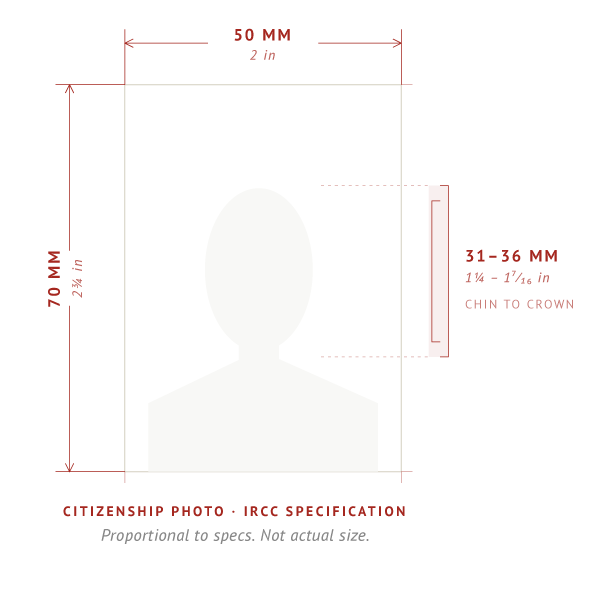
The standard citizenship photo specifications apply to children of every age, including newborns.
-
01
The newborn accommodation.
IRCC's official approach for newborns is a car seat with a plain white blanket draped over the seat behind the baby's head. They also recognize that "minor variations in a neutral expression of a newborn" are acceptable. The shadow rules still apply — no shadows around the ears, on the face or shoulders, or in the background. A professional citizenship photographer will know how to handle this.
-
02
Head and shoulders only — no hands.
The photo must show only the child's head and shoulders. A parent's hand visible at the edge of the frame — even just fingertips — is an automatic rejection, as is a sibling in the background or any object in the child's hand.
Unlock → -
03
The six-month rule cuts harder for babies.
Photos must be taken within six months of submitting the application — same as for adults. But a six-month-old looks meaningfully different from a newborn, and a reviewer is more likely to question infant photos near the edge of the window. If your application takes a few months to assemble, take the photo as late in the process as possible, not at the start.
Unlock →
COMMON QUESTIONS
Four things parents ask.
I'm a single or divorced parent. Do I need my ex to sign anything?
No. CIT 0001 requires one parent or legal guardian's signature, not both. Your custody arrangement, divorce status, or your ex's cooperation (or lack of it) doesn't affect your ability to apply on your child's behalf. You sign as the parent, you file the application, and IRCC processes it. There is no second-parent consent requirement and no custody documentation needed unless someone other than a biological or adoptive parent is the one applying.
My child only has one form of ID. Will the application be rejected?
No — IRCC explicitly accommodates this for minors. If your child doesn't have two pieces of ID, or doesn't have any photo ID, include an explanation letter with the application that says so. The two-ID rule still applies in principle, but the explanation letter satisfies it for children. The two-ID rule page covers what counts as ID and how to write the letter.
Can I file my own application and my children's together?
Yes — and IRCC encourages it. Each applicant (you and each child) needs their own complete CIT 0001 with their own supporting documents and their own $75 fee, but the applications go in a single envelope with one cover letter listing everyone. The CIT 0001 form itself explicitly says: "If you are sending more than one application, send all of them together in one envelope." This is also the most common way multi-generation families file.
My child is adopted. Does that change the application?
It might, depending on when and how the adoption was finalized. If your child was adopted in Canada or has already been recognized as a Canadian citizen through adoption, CIT 0001 is the correct form. If they were adopted outside Canada and haven't been granted Canadian citizenship yet, a different form (CIT 0003) applies. Adoption rules for citizenship are complex enough that we won't summarize them here — see IRCC's adoption and citizenship page for the actual rules.
KEEP GOING
Where these rules fit in the process.
Minor-specific advice ends here. From this point, your child's application follows the same workflow as any other applicant.
→ REQUESTING RECORDS
Get the documents
Birth, marriage, and death records for your child, you, and every generation back to your Canadian-born ancestor — including province-by-province guidance on where to request what.
→ TWO-ID RULE
What counts as ID
The full list of acceptable IDs for IRCC, what doesn't count, and how to write the explanation letter when your child can't meet the standard requirement.
→ TEMPLATES
Cover letters and summaries
The cover letter for a family filing, the line of descent template, and the generational evidence summary — built for the multi-generation applications that include minor children.
ONE-TIME PURCHASE
Full access for $39.
Every template, every topic page, every answer. No subscription. No recurring fees.
Get the Resource Hub →Not affiliated with IRCC. Informational only.
